Quantcast Top 10|Social media|How to|Blogging & Resources|Guides: web search engine
Showing posts with label web search engine. Show all posts

Saturday, June 4, 2011

WordPress SEO

The Definitive Guide To Higher Rankings For Your Blog

I started writing my beginner's guide to WordPress SEO a while back, and have since done a load of posts on the subject, an article in the Search Marketing Standard, newsletters, and presentations. It's time to let all the info of all these different articles fall into one big piece: the final guide to WordPress SEO.
Note: this article hasn't been updated yet since the beta release of my WordPress SEO plugin, but that plugin does cover a lot of the stuff needed below, so do check it out! When that plugin goes into a more stable development mode, this article will of course be updated.
If you're more of a visual type, try this WordPress SEO video. It's an hour long presentation I gave at A4UExpo London, that covers most of what's in here too. If you'd rather have me figure out what you should be doing, feel free to order a full site analysis by yours truly.
2009 SEMMY Winner Blogs & Blogging categoryAs search, SEO, and the WordPress platform evolve I will keep this article up to date with best practices. If you don't have the time to do this kind of optimization yourself, consider hiring us to do it, check out our WordPress consulting services.
As I take quite a holistic view on SEO, this guide will cover quite a lot, check out the table of contents for some quick jumping around.

1. Basic technical optimization

Out of the box, WordPress is a pretty well optimized system, and does a far better job at allowing every single page to be indexed than every other CMS I have used. But there's a few things you should do to make it a lot easier still to work with.
The first thing to change is your permalink structure. In WordPress 2.5, you'll find this page under Settings -> Permalinks. The default permalink is
?p=, but I prefer to use either /post-name/ or /category/post-name/. For the first option, you change the "custom" setting into /%postname%/:
Change the setting of your permalink structure to Custom: /%postname%/
To include the category, you change it to /%category%/%postname%/.
Once you've done that, you'll want to install the Redirection plugin, and make sure that under Manage -> Redirection -> Options, making sure both URL Monitoring select boxes are set to "Modified posts". Now you can change those permalinks to perfectly SEO'd permalinks without having to do anything else, or worry about the search engine consequences.
WWW vs non-WWW
Another good thing to configure now you're on that screen anyway is the Root domain: Add WWW / Strip WWW one. Make a choice, and set it here, don't enable both, some search engines still can't handle that. And enable the redirect index.php/index.html one too, it won't hurt you, and might even do your WordPress SEO some good.
URL stopwords
The last thing you'll want to do about your permalinks to increase your WordPress SEO, is install the SEO Slugs plugin, this will automatically remove stop words from your slugs once you save a post, so you won't get those ugly long URL's when you do a sentence style post title.

Optimize your Titles for SEO

By default, the title for your blog posts is "Blog title » Blog Archive » Keyword rich post title". For your WordPress blog to get the traffic it deserves, this should be the other way around, for two reasons:
  • Search engines put more weight on the early words, so if your keywords are near the start of the page title you are more likely to rank well.
  • People scanning result pages see the early words first. If your keywords are at the start of your listing your page is more likely to get clicked on.
For more info on how to craft good titles for your posts, see this excellent article and video by Aaron Wall: Google & SEO Friendly Page Titles. I prefer to do this with HeadSpace, as that makes it very very easy. You should check your header.php though, and make sure that the code for wp_title(); contains two quotes, so it looks like this: wp_title('');. This makes sure you have absolute control over the title and don't have any annoying separator in there.
After that, go into the HeadSpace settings, and make them look something like this for your posts and pages:
HeadSpace settings for Posts and Pages
For the other pages, I have the following settings:
  • Posts / Pages: %%title%% - Blog Title
  • Categories: %%category%% Archives %%page%% - Blog Title
  • Tags: %%tag%% Archives %%page%% - Blog Title
  • Archives: Blog Archives %%page%% - Blog Title
With HeadSpace, you can also write optimized titles for each post specifically, overriding the settings here. This way you have absolute control over your titles, and can make sure your WordPress titles are actually helping your SEO.

1.3. Optimize your Descriptions

Give each category a decent description, and use HeadSpace to add that description to the meta description, by adding %%category_description%% in the Description field. After that, write a description for each post or page that you actually want to rank with. The descriptions has one very important function: enticing people to click, so make sure it states what's in the page they're clicking towards, and that it gets their attention.
Automated descriptions
In my opinion, auto generating descriptions is a load of bull, most plugins pick the first sentence, which might be an introductory sentence which has hardly anything to do with the subject, or another sentence with a keyword in it, which might be completely wrong to pick as description. Thus, the only well written description is a hand written one, and if you're thinking of auto generating the meta description, you might as well not do anything and let the search engine control the snippet... If you don't use the meta description, the search engine will find the keyword searched for in your document, and automatically pick a string around that, which gives you a bolded word or two in the results page.
Auto generating a snippet is a "shortcut", and there are no real shortcuts in (WordPress) SEO (none that work anyway).

1.4. Optimize the More text

Another neat featuer of HeadSpace is that you can use it to optimize the more text, so if you use a more tag on the frontpage, you can replace the default "Read more" link with something meaningful for every post. It's small things like that that make your WordPress SEO the best.

1.5. Image Optimization

An often overlooked part of WordPress SEO is how you handle your images. By doing stuff like writing good alt tags for images and thinking of how you name the files, you can get yourself a bit of extra traffic from the different image search engines. Next to that, you're helping out your lesser able readers who check out your site in a screen reader, to make sense of what's otherwise hidden to them.
You should of course be writing good titles and alt tags for each and every image, however, if you don't have the time for that, there is a plugin that can help you. The plugin is called SEO Friendly Images, and it can automatically add the title of the post and or the image name to the image's alt and title tag:
SEO Friendly Images settings example

2. Template Optimization

You'll want to add breadcrumbs to your single posts and pages. Breadcrumbs are the links, usually above the title post, that look like "Home > Articles > WordPress SEO". They are good for two things:
  • They allow your users to easily navigate your site.
  • They allow search engines to determine the structure of your site more easily.
These breadcrumbs should link back to the homepage, and the category the post is in. If the post is in multiple categories it should pick one. For that to work, adapt single.php and page.php in your theme, and use my breadcrumb plugin.

2.2. Headings

Although most themes for WordPress get this right, make sure your post title is an

, and nothing else. Your blog's name should only be an

on your frontpage, and on single, post, and category pages, it should be no more than an

.
These are easy to edit in the post.php and page.php templates. To learn more about why proper headings are important read this article on Semantic HTML and SEO.

2.3. Clean up your code

All that javascript and CSS you might have in your template files, move that to external javascripts and css files, and keep your templates clean, as they're not doing your WordPress SEO any good. This makes sure your users can cache those files on first load, and search engines don't have to download them most of the time.

2.4. Aim for speed

A very important factor in how many pages a search engine will spider on your blog each day, is how speedy your blog loads. You can do two things to increase the speed of your WordPress.
  1. Optimize the template to do as small an amount of database calls as necessary. I've highlighted how to do this in my post about speeding up WordPress.
  2. Install a caching plugin. I highly recommend WP-Super-Cache, which is a bit of work to set up, but that should make your blog an awful lot faster.
Also, be aware that underpaying for hosting, is not wise. If you actually want to succeed with your link-bait actions, and want your blog to sustain high loads, go for a good hosting package. I've recently switched to VPS.net myself, and they've proven to be better than anything I've ever seen in hosting, if you want to know more be sure to read my article about WordPress hosting.

2.5. Rethink that Sidebar

Do you really need to link out to all your buddies in your blogroll site wide? Or is it perhaps wiser to just do that on your front page? Google and other search engines these days heavily discount site wide links, so you're not really doing your friends any more favor by giving them that site wide link, nor are you helping yourself: you're allowing your visitors to get out of your site everywhere, when you actually want them to browse around a bit.
The same goes for the search engines: on single post pages, these links aren't necessarily related to the topic at hand, and thus aren't helping you at all. Thus: get rid of them. There are probably more widgets like these that only make sense on the homepage, and others that you'd only want on sub pages.
Some day you will probably be able to change this from inside WordPress, right now it forces you to either use two sidebars, one on the homepage and one on sub pages, or write specific plugins.

3. Advanced WordPress SEO and Duplicate Content

Once you've done all the basic stuff, you'll find that the rest of the problems amount to one simple thing: duplicate content. Loads of it in fact. Out of the box, WordPress comes with a few different types of taxonomy:
  1. date based
  2. category based
  3. tag based
Next to that, it seems to think you actually need to be able to click on from page to page starting at the frontpage, way back to the first post you ever did. Last but not least, each author has his own archive too, under /author//, resulting in completely duplicate content on single author blogs.
In essence that means that, worst case scenario, a post is available on 5 pages outside of the single page where it should be available. We're going to get rid of all those duplicate content pools, by still allowing them to be spidered, but not indexed, and fixing the pagination issues that come with these things.

3.1. Noindex, follow archive pages

Install my robots meta plugin, and make sure the settings prevent indexing of all archive pages, like this:
Robots Meta setting to prevent indexing of archives to improve WordPress SEO
Now the search engine will follow all the links on these archive pages, but it won't show those pages in the index. Not everybody will agree on this policy, and others will tell you to just show a snippet of each post on the archive page. That'll also work, but in my opinion completely throwing them out is better.

3.2. Disable unnecessary archives

If your blog is a one author blog, or you don't think you need author archives, use the robots-meta plugin to disable the author archives. Also, if you don't think you need a date based archive: disable it. Even if you're not using these archives in your template, someone might link to them and thus break your WordPress SEO...

3.3. Pagination

Thirdly, you'll want to make sure that if a bot goes to a category page, it can reach all underlying pages without any trouble. Otherwise, if you have a lot of posts in a category, a bot might have to go back 10 pages before being able to find the link to one of your awesome earlier posts...
There's an easy fix. Jaimie Sirovich wrote Pagerfix, a plugin that helps you make your pagination look like this:
Better Pagination to increase your WordPress SEO
To reach that, install that plugin, and change this section in f.i. your index.php:
Into this:
Do that in your index.php, your archives.php, and all other archive templates you might have.

3.4. Nofollowing unnecessary links

Another easy step to increase your WordPress SEO is to stop linking to your login and registration pages from each and every page on your blog. The same goes for your RSS feeds, your subscribe by e-mail link, etc. Robots Meta has an option to nofollow all your login and registration links. You'll probably have to go into your RSS links and nofollow those by hand. If you're using the meta widget, you might want to enable the option in robots meta to replace that with one that has nofollowed links.

4. A site structure for high rankings

Blogs are spidered so easily due to their structure of categories, tags etc.: all articles are well linked, and usually the markup is nice and clean. However, all this comes at a price: your ranking strength is diluted. They're diluted by one simple thing: comments.

4.1. Pages instead of posts

You've probably noticed by now, or you're seeing now, that this WordPress SEO post is actually... not a post. It's a page. Why? Well for several reasons. First of all, this article needed to be a "daughter"-page of my WordPress page, to be in the correct place on this blog. Secondly, to rank for the term [WordPress SEO], this article has to have the right keyword density. And that's where things go wrong. Comments destroy your carefully constructed keyword density.
That's why I decided to make my most important articles into pages. That way, you can easily update them and do a new post about what you've changed.

4.2. New wine in an old bottle

If a post on your blog becomes incredibly popular and starts to rank for a nice keyword, like mine did for WordPress SEO, you could do the following:
  • create a new page with updated and improved content
  • change the slug of the old post to post-name-original
  • publish the new page under the old post's URL, or redirect the old post's URL to the new URL
  • send an e-mail to everyone who linked to your old post that you've updated and improved on your old post
  • wait for the links to come in, again;
  • rank even higher for your desired term as you've now got:
    • more control over the keyword density
    • even more links pointing at the article
    • the ability to keep updating the article as you see fit to improve on it's content and ranking
Some among you will say: I could have 301 redirected the old post to the new one with the same effect. True. Except: you'd lose the comments on the old post, which is in my opinion a sign of disrespect to people who took the time to comment, and 301 redirects take quite a bit of time sometimes. Of course you should treat this technique with care, and not abuse it to rank other products, but I think it can be done in everyone's benefit. For instance this article: if you came here through a social media site like Sphinn, expecting an article about WordPress SEO, that's exactly what you got!
One way of getting search engines to get to your older content a bit easier, thus increasing your WordPress SEO capabilites a LOT, is by using a related posts plugin. These plugins search through your posts database to find posts with the same subject, and add links to these posts.
There's a load of these available, but I just use the one that comes with the Simple Tags plugin, as I've found that the easiest and best one so far.

5. Conversion optimization

Get those readers to subscribe!

A lot of bloggers still think that because their blog is a blog, they don't have to optimize anything. Wrong. To get people to link to you, they have to read your blog. And what do you think is easier: getting someone who is already visiting your blog to visit regularly and then link to your blog, or getting someone who visits your blog for the first time to link to your blog immediately? Right.
That's why conversion optimization is so vitally important to bloggers as well: they need to learn how to test their call to actions on their blog so that more people will subscribe, either by e-mail or by RSS. (Ow btw, if you haven't subscribed to this blog yet, do it now!)
One of the things I've found to be very important, and more bloggers seem to have found this, is that a BIG RSS subscribe button is very important, as is offering a way to subscribe by e-mail. I even offer daily and weekly e-mail subscribe options, using aweber (aff), and have found that people tend to really like those options too.
Another thing to be very aware of is when people might want to subscribe to your blog. If they've just finished reading an article of yours, and really liked it, that would be the ideal time to reach them, right? That's why more and more people are adding lines like this to the end of their posts: "Liked this post? Subscribe to my RSS feed and get loads more!"
Another great time to get people to subscribe is when people have just commented on your blog for the first time, for which purpose I use my own comment redirect plugin. Which leads me to the next major aspect of WordPress SEO:

6. Comment optimization

Get those readers involved

Comments are one of the most important aspects of blogs. As Wikipedia states:
The ability for readers to leave comments in an interactive format is an important part of many blogs.
Comments are not only nice because people tell you how special you are, or that you made a mistake, or whatever else they have to tell you. Most of all they're nice, because they show engagement. And engagement is one of the most important factors of getting people to link to you: they show you they care, and they open the conversation, now all you have to do is respond, and you're building a relationship!

6.1. How you get people to comment

The easiest way of getting people to do anything is: ask them to do it. Write in an engaging style, and then ask your blog's readers for an opinion, their take on the story etc.
Another important things is your comment links. Is your comment link "No comments »"? Or is it "No Comments yet, your thoughts are welcome »"? Feel the difference? You can change this by opening your index.php template, search for comments_popup_link() and changing the texts within that function.

6.2. Bond with your commenters

Another thing to do is thank people when they've commented on your weblog. Not every time, because that get's annoying, but doing it the first time is a very good idea.
Justin Shattuck thought the same, and created the Comment Relish plugin which sends an email after someone has made his first comment. This email is a message you can enter yourself, with for instance your feed URL, and in my case, a newsletter subscribe URL, etc. Note that some people think this is spam, and that laws in several countries might prohibit the use of this. I can't tell you, because I'm not a lawyer.
Another option, which is a bit less obtrusive / spammy, is to install my comment redirect plugin. This plugin allows you to redirect people who have made their first comment to a specific "thank you" page.

6.3. Keeping people in the conversation

Now that people have joined the conversation on your blog, you should make sure they stay in the conversation. That's why you should install the subscribe to comments plugin, that allows people to subscribe to a comment thread just like they would in a forum, and sends them an e-mail on each new comment. This way, you can keep the conversation going, and maybe your readers will be giving you new angles for new posts.

7. Off site blog SEO

If you've followed all of the above WordPress SEO advice, you've got a big chance of becoming successfull, both as a blogger and in the search engines. Now the last step sounds easy, but isn't. Go out there, and talk to people online.

7.1 Follow your commenters

There's been a movement on the web for a while now that's called the "You comment - I follow". They want you to remove the nofollow tag off of your comments to "reward" your visitors. Now I do agree, but... That get's you a whole lot of spam once your WordPress blog turns into a well ranked blog... What I do advocate though, is that you actually follow your visitors! Go to their websites, and leave a comment on one of their articles, a good, insightful comment, so they respect you even more.
If you think that's a lot of work, do realize that, on average, about 1% of your visitors will actually leave a comment. That's a group of people you have to take care of!

7.2. Use Twitter

Twitter is a cool form of micro-blogging / chatting / whatever you want to call it. Almost all the "cool" people are on there, and they read their tweets more often than they read their e-mail, if you even knew how to reach them through e-mail.
To boot, if you use WordTwit or Twitter Tools, all of your posts can be announced on Twitter, which will usually get you quite a few early readers! People will feel even more happy to comment on Twitter, which might get you into an extra conversation or two.

7.3. Find related blogs, and work them

If you want to rank for certain keywords, go into Google Blogsearch, and see which blogs rank in the top 10 for those keywords. Read those blogs, start posting insightful comments, follow up on their posts by doing a post on your own blog and link back to them: communicate! The only way to get the links you'll need to rank is to be a part of the community.

8. Conclusions on WordPress SEO

This guide gives you a lot of stuff you can do on your blog. It goes from technical tips, to conversion tips, to content tips, to conversation tips, and a whole lot in between. There's a catch though: if you want to rank for highly competitive terms, you'll have to actually do most of it.
If you want to keep updated on the latest news about WordPress, and hear more tips as I come up with them, then subscribe to my WordPress mailing-list right now. If you need help implementing all the tips in this article, or want me to review whether you've done a good job implementing it all, order a full site analysis!
Enhanced by Zemanta

Sunday, December 5, 2010

SEO Tip: Google Insights for Search

image

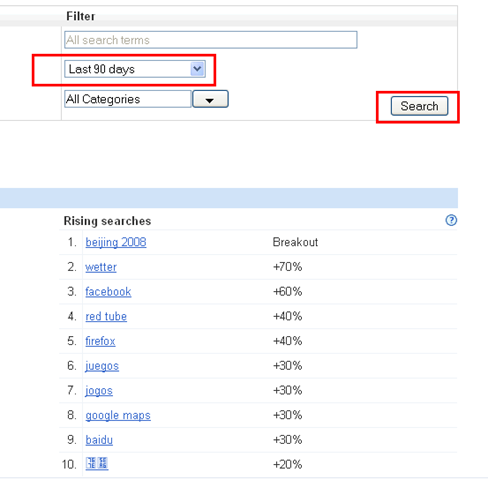
The Google Insights let you see what people are searching for.  The first time I used it, I chose last 90 days then I clicked the Search button. The output was a list of Rising Searches of the last 90 days:

image

Rising searches are defined as searches that gained significant growth from the specific time period.  This makes sense if you want to know what keywords people are looking for.  It is also a good way to discover popular things that you might not be aware of (i.e. in my case it is red tube, item #4, further search lead me to a porn site!).

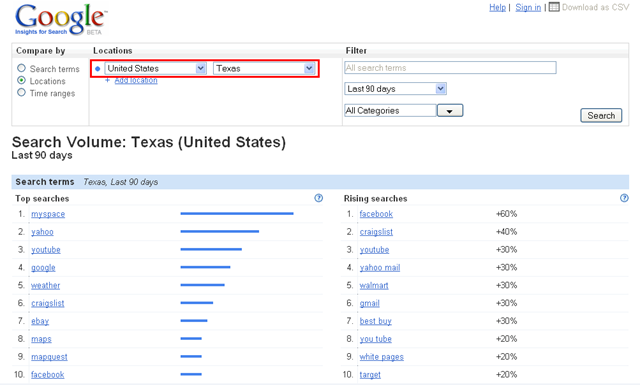
To zoom in on a specific locale, choose the country and specific location you want to analyze.  In the example below I searched for Texas, USA:

image

The top searches included search engines, youtube, and shopping sites like ebay and craigslist.  The result is too broad as expected, so let’s see if we can narrow it down to a specific category:

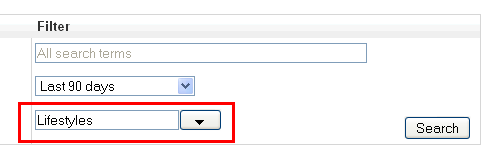
To do this, choose a category on the Filter panel.  I chose Lifestyles for the example below:

image

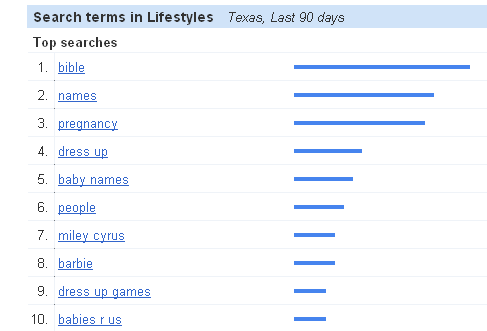
The output is now a little more interesting:

image

The top 3 searches are bible, names, pregnancy.  Top 5 entry is “baby names”, while top 10 is “babies r us”.  From this alone, I can conclude that Texas could be a good market for companies who sell baby stuff.
Now for the Rising searches… at the top is Shelley Malil, she must be a celebrity or something… this proves my theory that I could be connected to the Internet for the most part of my entire day Digging and still miss a famous person that everyone else is searching for.

image

After a Wikipedia research http://en.wikipedia.org/wiki/Shelley_Malil, I found out that Shelley Malil is not a woman but a man! He appeared in a movie called the 40 Year Old Virgin but people are digging him because he is a suspect for stabbing his ex-girlfriend at-least 20 times!  Indeed gruesome but that is how he got to the top of the searched entries.

The best feature for me of this tool is it’s capability to map out the planet and color code the volume of search for a specific keyword.  I typed in “Paris Hilton” and I got the interesting results below:

image

The darker the color of the map, the heavier the search interest.  The Chinese seem to have less interest to Paris Hilton than the Australians.  Makes sense, the Chinese have their own share of celebrities caught on their own homemade videos.  From the list of countries, Honduras tops the list. Seems the Hondurans like to search for Paris Hilton more than the Americans.

Overall, Google Insights is a great tool for researchers and SEOs.  The capability to view the regions (countries) and cities color coded by the search volume is an easy way to gain an insight to what locales are searching for any keyword. The capability to narrow a search via categories are very helpful on identifying a specific target market or audience.

-------------------------------------------------------------
GREAT 2 SITES 2 JOIN-

1.


2.
Enhanced by Zemanta

Friday, December 3, 2010

Get keyword ideas using the Google Keyword Tool

Search engines use keywords to identify which sites match a particular search phrase.  SEOs need to identify which keywords are searched for so that they can use those keywords and get found by the search engines and eventually by their target audience. 


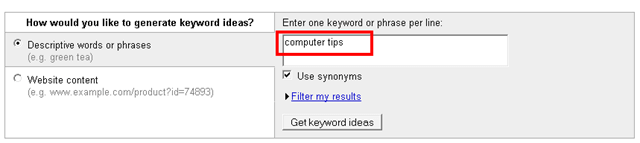
For example, if you want to optimize a website about “computer tips” you should see how many searches for the keyword are being submitted to Google monthly so you can have an idea if readers are looking for you or not. You can do that by going to external Google Keyword Tool:


Enter the keyword or phrase that you want to analyze then click Get keyword ideas:

image

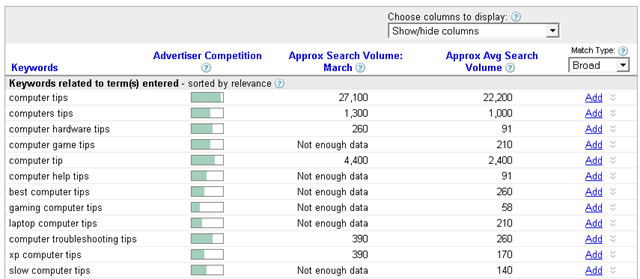
You will see a tabular report of all related terms along with the search volume generated for the previous month and the average search volume.

image

In this report you will see if you are using the right keywords based on the Google search database. If you think you should target “computer tip” instead of “computer tips” then think again because the difference on the performance of each phrase is about ten times for “computer tips” (22,200 VS 2,400).

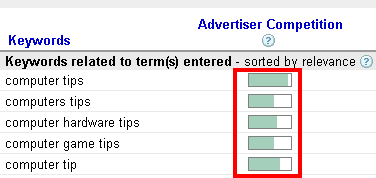
Also take note of the advertiser competition information, the longer the bar the more fierce the competition:

image

If you are a starting up a new web site and the competition is strong, it is a good idea to start with keywords with less competition then work on those higher volume keywords later.

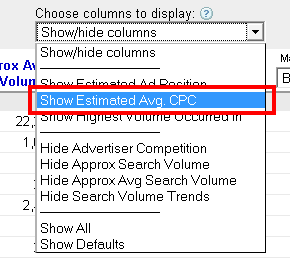
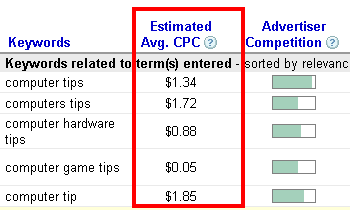
Another cool feature of this tool is that it can show you the average cost each time a user clicks your ad on the associated keyword.  To add the estimate cost per click (CPC) column on the report, go to the dropdown selection labeled “Choose columns to display” then click “Show estimated Avg. CPC”.

image

You should see the CPC column on the report:

image

Isn’t it a very convenient way to analyze your web site’s earning potential?  This way you can earn more money by targeting keywords with higher CPC.  Well, that is of course if you can make them come to your website.  We will show you how to do just that in the future articles as we go into more in-depth SEO tips.

-------------------------------------------------------------
GREAT 2 SITES 2 JOIN-

1.


2.
Enhanced by Zemanta

Wednesday, November 24, 2010

How to write blog post titles while keeping SEO in mind

How many times do you happen upon a post written by a fellow blogger whose title makes you wonder what the post will actually end up being about? Note that many times that you do run across these posts, they do not have a high PageRank or get very much traffic unless they have been Dugg, etc. And even if they do, could they get more traffic if their post title was optimized?

When I first starting writing for my blog in March of this year, I didn’t even know what the term SEO meant and hence wrote post titles that would make a seasoned blogger cringe! Even though I have read it over 100 thousand times, it seems that a lot of bloggers out there still don’t understand how important it is to write a good title for each post.

And what’s more baffling is that everyone intrinsically knows how important titles are because each person reads a newspaper on a daily basis. For example, if you were to whip open the New York Times web site right now, the top headline is as follows:

New Stem Cell Method Could Ease Ethical Concerns
Now that title makes sense! It’s also very search engine friendly since it’s short, yet has enough keywords that it would show up in a long tail search. Now consider what you would think if you were to read the following headline:

“Medical Ethics”

If that were the title for the above article, do you think it would be as easily searchable through Google as the first title? HELL NO. And you may read this and laugh and say that “Awww come on man, that’s retarded, that title is not even close to being a short form of the original title, it’s not close at all!” Well I would agree with you, but that’s a major problem with many blog post titles, they have nothing to do with the content!
As a technology blogger myself, I find this issue to be even worse among our niche because most bloggers are writing about software, computers, technology, and other items whose names don’t have anything to do with their ultimate purpose. 

For example, here’s a couple of blog posts that I feel are really bad post titles because they lack keywords, do not describe anything, and are just plain useless to the search engines.

Bad Post Titles

Unlocker for Windows” – This blogger is writing about a piece of software that you can use in Windows to get past errors like “Access is Denied” when trying to delete or move files. Does anyone search on Google for UNLOCKER FOR WINDOWS? Of course not, someone is searching for “cannot move file” and “access is denied”. A better title for this would be “How to unlock a process for access is denied errors in Windows” or something similar. 

“iConcertCal”This article was Dugg, but still who is ever going to find this product with this kind of title? The software monitors your iTunes library and lets you find concerts in your local area. A good title would be “iConcertCal – Find local concerts in your city via your iTunes libarary”.  At least write something!

HeatEatReview” – This is a great site that reviews all kinds of frozen dinners, etc so that you can buy the best stuff from the store. But who the hell is going to search HeatEatReview! Even some simple text after the name of the site will be much better.

Joox.net – Can you guess what this site is all about? No idea? Well obviously since Joox is not even a word! This site allows you to watch some old and new movies in DivX quality. Would it not be better to write something like “Joox.net – Watch Hollywood DivX movies online for free”???
So what is considered a good title? Well, you’ve probably seen most of those already, but I thought I would mention a few anyway.

Good Post Titles

Stage6 – Upload video clips, share, watch, download videos” – This site is similar to the Joox.net site mentioned above, but look at how much more descriptive the title is. It has all the keywords that it wants to rank on included in the title. No one knows what Stage6 means and nor do the search engines!

Photojojo – The best photo tips, DIY projects, and gear in the whole wide world’Can anyone possibly be confused by what this site is all about? Not even a search engine! Good keywords and pretty straight forward.

“Dealing With Website Plagiarism: When Someone Copies Your Blog Content”If someone were to steal your blog content, what would you search for first? Probably something like “blog plagiarism” or “blog content stolen”, etc. This article will probably show up higher since the keywords will match in the title.

Conclusion

So when writing post titles, always try to think from a searchers perspective and what they would type in if they were looking for this product or service. Yes, backlinks and the content of the post matter a lot and I’m not denying that, I’m just saying that if ALL OTHER FACTORS WERE EQUAL, the post with the better title would win out.


Also, I’ve noticed that if someone is not paying attention to writing correct post titles, they are probably also missing important keywords in the body of the content. If you’re not sure what keywords to use, check out keywords tools such as Google’s Adwords tool or Keyword Discovery.

Any comments or thoughts? Post a comment! Thanks! 

------------------------------------------------------------
.
GREAT 2 SITES 2 JOIN-

1.


2.

Enhanced by Zemanta

Saturday, October 9, 2010

Top 10 discussed ways to Reduce Bounce Rate Of A Blog Or Website

It's better late then never, maybe you might have ignored your analytics bounce rate for a long time but don't worry you can still work on it and get those high bars down. It's a normal problem faced by bloggers and website owners to get more than one page views from their visitors. This is something that no one has control over because you can't tell your visitors to visit all pages of your blogs but you can always guide them to visit another page on your blog.


Bounce Rate: the percentage of web site visitors who arrive at an entry page on your web site, then leave without visiting any other pages or leave without going any deeper into the site. Bounce rate is typically measured as a percentage. The lower the bounce rate that you have the better as this is an indicator of how users are engaging with your website.

In order to understand bounce rate, you must identify it within your site analytics. Google Analytics makes this easy by placing bounce rate as default item on your main analytics dashboard. This says something in itself, if Google has included bounce rate as a metric on the dashboard, they must think that bounce rate is a fairly important metric right? Well in fact it is a key metric when measuring user engagement on your site. A high bounce rate is a good indication that users are not finding the information that they are looking for and as a result are not proceeding any further.


What is a Good Bounce Rate Anyways?

Great question. We're glad you asked. As with many items in the world of SEO and organic search, the answer is it depends. Obviously a lower bounce rate is better, but bounce rate averages can vary by industry or type of site. Sites that are information portals will most likely have lower bounce rates than sites that feature limited content. The fact is that bounce rate is affected by the user's intent. That is, based on the user's query did they find the information that they were looking for? For example let's say you were looking for information about the TV program Las Vegas and you typed in "Las Vegas" in a search engine. You would no doubt receive a lot of Las Vegas (the city) related sites and potentially you might even be returned with a result that talks about the TV show albeit briefly. You might click through to some of these sites but unless the information that you were looking for about the show is present you would most likely revisit the search results page and/or re-enter a more specific search query. The bounce rate of the sites that you did click through would be affected as you were unable to find the information that you were looking for.

So to answer the question, what is a good bounce rate, generally speaking if you have a bounce rate that is in the 40-50% range that is not bad. If you manage to have an overall bounce rate that is in the 30-40% that is fantastic. As Avinash Kaushik states "a 35% bounce rate is very good..." We'll add that anything less is pretty spectacular. For the record, we've worked with clients and have helped them lower their bounce rates to less than 20% and in some cases to 7 or 8% which is quite exceptional.

So the question becomes, how do we lower bounce rate?


1.Use good quality, fresh content

Naturally, if you want visitors to stick around, your content should be worth reading and regularly updated. This also ensures that your content gets linked to from other sites, which will in turn increase your traffic.
It also helps to make your content easy to read. Learn the rules for writing good Web copy: Use short, single-topic paragraphs; condense content to bullet lists; highlight important phrases in bold; keep page lengths short.

2.Make sure the content is relevant

In order to engage visitors, your site's content needs to focus on the topic that those visitors are interested in.
  • Each page of your site, as well as the site overall, should be on-topic. For example, if your site is about dog breeding, don't have a page on the site that discusses horses.
  • Think about your site's overall objective, as well as your audience. Does all of your content help to achieve your site goals, and is it content that your audience want to see?
  • Use the Google Analytics Keywords report to see what people are searching for when they reach your site. Are you attracting a lot of traffic for keywords that have high bounce rates? Maybe it would be good to add some new content that gives visitors the information they are searching for.
  • Each page's title should match the content within the page. Don't use misleading page titles.

3.Use "related info" links

A great way to encourage visitors to read more than a single page of your site is to offer links to related information on the page.
For example, a product page might have a list of links to related products. Similarly, you could add a list of related articles or a "further reading" list at the end of an article page.

4.Use a professional, authoritative site design

First impressions count. When a visitor first lands on your site, the look of your site design can influence the visitor's decision to stay or leave. Generally speaking:
  • A professional, appropriate design lends an air of authority, inspiring confidence in the visitor and encouraging them to explore your site further.
  • An amateur or unattractive design can put people off and send them back to the search engines. It can also make your site harder to navigate, which means that visitors will spend less time exploring your site.
Of course, you may not be a professional designer, or you may not have the budget to hire one. However, there are some basic design rules — such as minimizing the number of colours and fonts in the page — that can have a big impact.


5.User-test your landing pages

Testing your site with real people can be a great way to find out the underlying causes of high bounce rates.
Show your key landing pages — particularly those with high bounce rates — to friends and colleagues. Ask them what attracts them on each page, and what turns them off. Are they inclined to buy your products or explore your site further? Or is there something about the page that discourages them from staying on your site?


6.A/B test your landing pages

As well as testing your landing pages with friends and colleagues, you can run A/B tests on your pages: Randomly serve 2 different versions of a landing page, and see which page results in more sales or other conversions. Google Website Optimizer can help automate this process.
As an alternative to A/B testing, you can make improvements to 1 landing page and measure how the bounce rate changes compared to other landing pages. For example, if bounce rates generally stay the same or increase over the course of a month, but your changed landing page shows a drop in bounce rate over the same period, then the chances are good that your changes reduced that page's bounce rate.

7.Use clear calls to action

If the purpose of a landing page is to encourage the visitor to take action — such as buying a product, signing up for a newsletter, or exploring your site further — make sure the call to action is obvious. The call to action is an element of the page — such as a button or a piece of text — that indicates what the visitor should do next.
For example, if your landing page needs to encourage people to buy an ebook then a large "Buy The Book Now" button would work well.
It's also a good idea to reduce page clutter. Remove unnecessary or distracting elements from the page so that the call to action stands out.


8.Use clear navigation

If you want visitors to engage with your site and explore it more deeply, make sure your site navigation menu is easy to find and easy to understand.
  • Place the menu in an obvious place, such as near the top of the page.
  • Use clear, simple words for your navigation options. Don't use jargon.
  • Try not to have too many main nav links. A maximum of 7 links is a good rule of thumb.

9. Build targeted traffic

Work on getting more targeted traffic to your website. The only way to do is to start optimizing your website for search engines. I know it's a very time consuming task but it pays you in long term. Make sure you have corrected all the above mentioned points to start working on SEO for your website. If you somehow get high bounce rate from search engine traffic then shame on you and start over again on these tips and this time don't hurry.


10.Surprise element: 

In your post content try surprising your visitors by offering them some new information but remember that must be related to the content of that post and the surprise should be pleasant of course, don't piss them off deceiving them. This will build an excitement in your readers and he would be interested to see what he is to get more in your other blog posts.


Now take a look at your own site's bounce rate and see if you can lower it. By reducing your site's bounce rate, you're increasing visitor interaction on your site. This usually means happier visitors and a more successful site. Have fun!

-------------------------------------------------------------

 
GREAT 2 SITES 2 JOIN-

1.


2.


Enhanced by Zemanta

Monday, September 27, 2010

12 Free Keyword Research Tools For Webmasters

We all know that before writing any article or writing content for a website, selecting the right keywords is the most important aspect for a good visibility in search engine. And if I talk about myself, keyword research is a road to get higher traffic from search engines if you are using the right keywords for your article or website.

For finding best keywords for your blog, there are several keyword tools available online. Some of them are completely free to use while some are paid tools that also offers free version for a limited time. But there are so many keywords tools popping up online, you sometimes think which one is worth using. So, in this article, I am gathering the best free keyword research tools on the web that will help you to research the most appropriate keywords for your blog or website.

Most of these free keywords research tools will give you the analysis of amount of search for a particular given keyword phrase. This will help you to find the best keyword with higher search amount in the search engines.
So, here are the 12 Free Keyword Research Tools For Webmasters that will help you find the best keywords for your site. I believe these keyword research tools will give you great stats to work with. 

Don’t forget to Subscribe to our RSS-feed subscribe to my RSS-feed and Follow us on Twitter follow me on Twitter for recent updates.


1) Google Adwords Research Tools : Some time before, this tool is used mostly by Adwords bidders, but now many of the SEO professionals and webmasters check keywords according to the amount of Google search volume.


2) Google Search-based Keyword Tool : The Search-based Keyword Tool generates keyword and landing page ideas highly relevant and specific to your website. In doing so, the tool helps you identify additional advertising opportunities that aren’t currently being used in your AdWords ad campaigns. The tool goes one step further by tailoring the keywords and other data (such as the amount of competition for the keyword, the suggested bid, and more) based on your language or country/territory settings.


3) Keyword List Generator : This free keyword phrase generator tool is web based software which allows you to generate a large number of keyword phrases based on permutations of keywords you enter.


4) Wordtracker Free Keyword Suggestion Tools : Enter a starting keyword to generate up to 100 related keywords. And if you use Internet Explorer 7, or Firefox 2 or 3, you can add the Wordtracker Keywords search to these browsers.


5) Good Keywords : The main component of Good Keywords v3 is the Keyword Database Manager for the Google Keyword Tool. The Keyword Database tool in Good Keywords v3 is meant to help you get more out of your Google Keyword research. Its a small software of nearly 500 KB which you can download for free on your computer.


6) Google Insights For Search : With Google Insights for Search, you can compare search volume patterns across specific regions, categories, time frames and properties. There are several approximations that are used to compute the results.


7) Keyword Playground : The basis of ALL search engine rankings is keywords. Users enter keyphrases in Search Engines to get information they need, It is VERYimportant that you optimize for such keyphrases. This tool provides you keyword suggestions and reports on their monthly search estimates. This tools has been build using the WordTracker Database.


8 ) Free Search Term Suggestion Tool : This keyword suggestion tool is an alternative to Overture keyword Suggestion. There keyword data is compiled and collected from a number of search engines to provide a far more accurate cross section of searches performed world wide. Simply type a seed keyword in the blank field and have Keyword Discovery generate the top 100 keywords for you.


9) Google Trends : This tool is a offering from Google which allows you to compare multiple keywords to find the best keyword. Just place comma between every keyword phrase and it will compile a data which is mostly used and in trend.


10) SEOmoz : This tool is an aggregation of popular search queries gathered from various sources across the web like google trends, delicious, yahoo buzz, aol, glickr hot tags of a particular day. It also show top 10 search keywords for a particular date.


11) KGen : KGen is a Firefox extension that allows you to see what keywords are strong on visited web pages for search engines. KGen retrieves every words of a page and lets you know how many time they appears and their weight in the page and their average position in the web page. It give you some stats on the content of the page to allows you to improve your content quality. KGen’s also a good tool to view your competitors keyword strategy.


12) Niche Bot : Type a keyword or keyword phrase and get up to the 100 most popular keyword listings.


BACK-LINKCLICK HERE


-------------------------------------------------------------------

GREAT 2 SITES 2 JOIN-

1.


2.


Enhanced by Zemanta

STATS